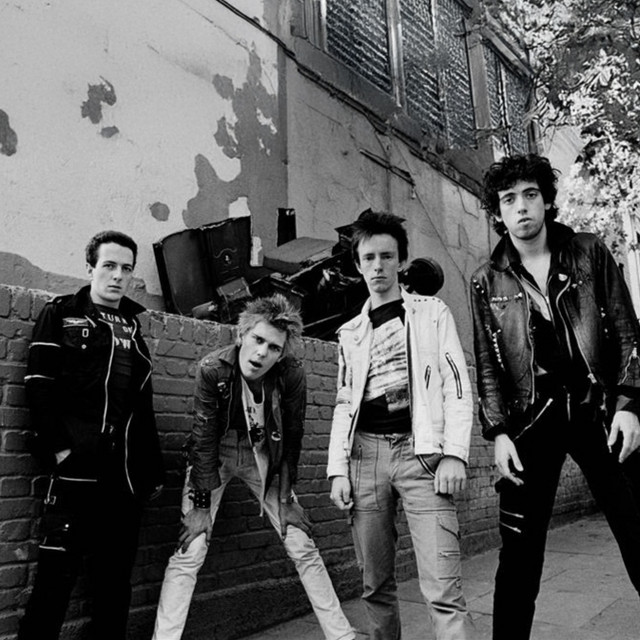
The Clash
Active: 1977–1991
24
Releases
15
Active Years
About The Clash
By Robert Williams
The Clash were never just a punk band. From their explosive debut in 77 to their messy dissolution in 86, they were somethin' more ambitious: a band that believed rock and roll could change the world, and acted as though the world depended on it. They became the most important and endurin' band to emerge from the original British punk explosion.
Formed in London in 76 by Joe Strummer (vocals, rhythm guitar) and Mick Jones (lead guitar, vocals), alongside Paul Simonon (bass) and Nicky 'Topper' Headon (drums). Their self-titled debut in 77 captured punk's raw furious energy — White Riot, London's Burnin', Career Opportunities. Strummer's gravel-throated conviction and Jones's melodic guitar work gave 'em a sound confrontational and irresistibly catchy. I've got the debut on vinyl, the original press with the pink cover.
But they refused to be confined by punk's three-chord orthodoxy. London Calling in 79 — an album that transcended punk entirely. A double LP rangin' across rockabilly, reggae, ska, R&B, and rock and roll. A sprawlin', electrifyin' statement of intent. The title track, written in response to a nuclear accident, became one of rock's greatest anthems. Train in Vain, The Guns of Brixton, Spanish Bombs — a band operatin' at the peak of its creative powers. Widely regarded as one of the greatest albums of all time.
They followed it with Sandinista! in 80, a triple-album of wilful sprawlin' excess, and Combat Rock in 82, which produced their biggest commercial success — Should I Stay or Should I Go and Rock the Casbah. The latter, a wry danceable take on Middle Eastern geopolitics, became an unlikely hit.
Politically, they were relentless. Strummer was a fiercely principled frontman who wore his convictions on his sleeve. Benefit concerts for strikin' miners, campaigned against racism and fascism, consistently used their platform to amplify voices mainstream rock ignored. Their embrace of reggae and dub — covers of Junior Murvin's Police and Thieves and work with Jamaican producer Lee 'Scratch' Perry — opened the door for a generation of British bands to look beyond rock's borders.
Disbanded in 86. Strummer's untimely death in 2002 at 50 only deepened the sense of what was lost. Their legend has only grown. The definitive punk band — not because they were the loudest or fastest, but because they believed music could be a force for good. In the story of British rock, The Clash are the conscience of the whole enterprise: angry, idealistic, and utterly essential.
Advertisement
Complete Discography
WHITE RIOT
Documented across 3 weeks
COMPLETE CONTROL
Documented across 2 weeks
CLASH CITY ROCKERS
Documented across 4 weeks
(WHITE MAN) IN HAMMERSMITH PALAIS
Documented across 7 weeks
TOMMY GUN
Documented across 10 weeks
ENGLISH CIVIL WAR
Documented across 6 weeks
THE COST OF LIVING E.P.
Documented across 8 weeks
LONDON CALLING
Documented across 9 weeks
BANKROBBER
Documented across 10 weeks
THE CALL UP
Documented across 4 weeks
HITSVILLE UK
Documented across 4 weeks
THE MAGNIFICENT SEVEN
Documented across 5 weeks
THIS IS RADIO CLASH
Documented across 5 weeks
KNOW YOUR RIGHTS
Documented across 3 weeks
ROCK THE CASBAH
Documented across 10 weeks
STRAIGHT TO HELL/SHOULD I STAY OR SHOULD I GO
Documented across 1 week
SHOULD I STAY OR SHOULD I GO/STRAIGHT TO HELL
Documented across 8 weeks
THIS IS ENGLAND
Documented across 5 weeks
I FOUGHT THE LAW {1988}
Documented across 6 weeks
LONDON CALLING {1988}
Documented across 3 weeks
RETURN TO BRIXTON
Documented across 2 weeks
SHOULD I STAY OR SHOULD I GO
Documented across 9 weeks
ROCK THE CASBAH {1991}
Documented across 6 weeks
LONDON CALLING {1991}
Documented across 2 weeks